
When we want to set our reminders we either choose to set them on our phones or have it written down on a planner.As busy students, it’s really important for us to find the perfect method. Sadly, the “perfect method” is nonexistent.In the current world of technology we assume most students rely on digital reminders and this survey proved it .
It is a rush everyday to get our work done on time, we wake up early for assignments and stay up late to complete them. We scribble notes into out planner to the smallest detail to not forget our work and tick what assignments we completed as we go. Another would type up their assignments and set up alarms to remind them, and wait for each alarm to go off. Assignments are done, then comes the rush of another day of work.
The traditional method of planning has worked for many years but being in the era of technology the traditional methods are being challenged.
The emergence and growth of the technology-dependent generation have led to a change in different aspects of life. Life has changed from the way business is conducted in the global market,to how information is passed and the way people interact. The issue of planning has not been an exemption to changes in technology. the current use of technological gadgets such as smartphones and tablets have changed the way planning is done. Most people have moved from paper planning to digital planning.
Paper planning is a form of planning whereby an individual writes down the things that should be done and the time that they should be done. Digital planning is a planning method whereby people set reminders in their technological gadgets to remind them of different occurrences in their busy schedules.
The theory of extended mind comes to light in this digital era. The“extended mind”is the idea that our minds go way beyond our “skull and skin”. It is how our minds are getting tuned and integrated into external elements that “include smartphones, tablets and at least some instances of wearable computing, but, in the end, less attention-grabbing items such as notebooks (the old-fashioned kind), tally sticks and abacuses would, under the right circumstances, do just as well.”(Wheeler 2018).
An online survey by SurveyMonkey was conducted to test the theory of Traditional Planners Vs. Tech Reminders in Education City for students. The students had to answer three questions: what university they are attending, what reminder method they use and why they choose this method.
A total of 46 students answered this survey and phone reminders was favored with 54% percent, traditional planner 33%, app reminders 9% and 4 % classified under “other” where one said brain and the other said both traditional and phone reminders.
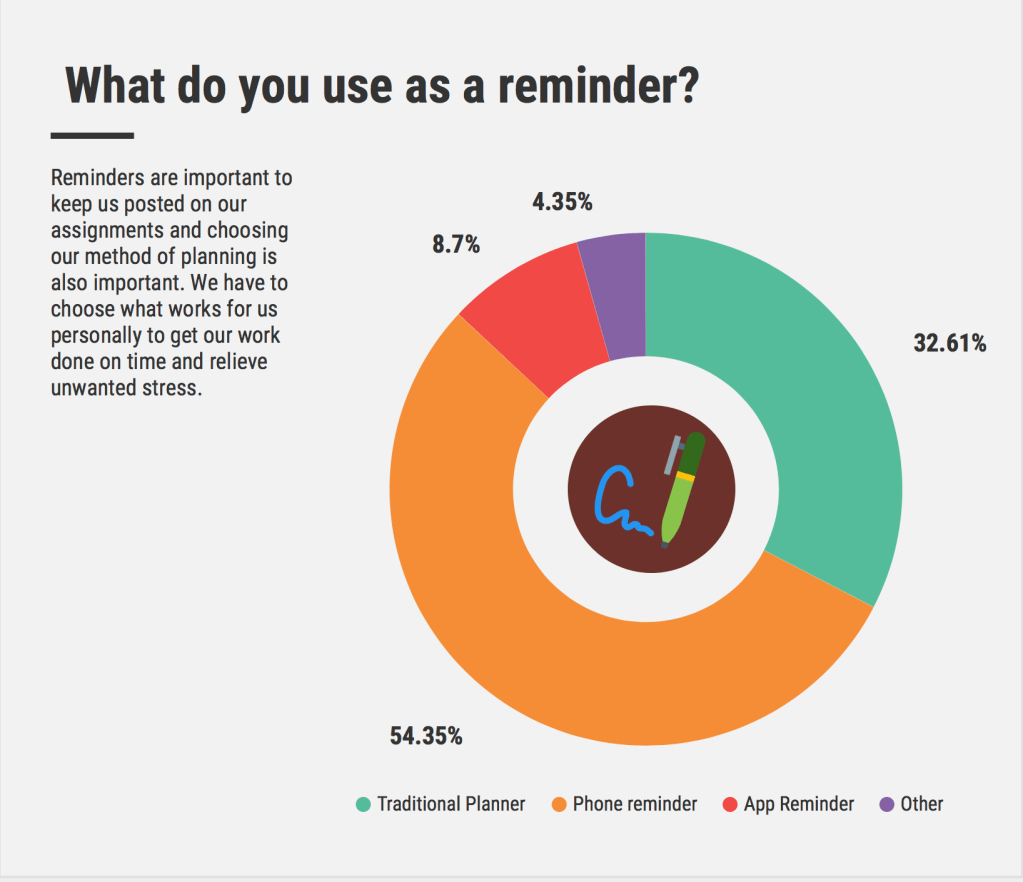
Students have commented about how phone reminders are much more useful because it sends notifications that keeps reminding them rather than planners where you have to physically open the book. Additionally, students have explained that it is also very convenient as their phones are always with them, so they are bound to see the notifications even if the phone was on silent and there is no extra weight with having to carry a planner all day but the other 33% don’t agree. They believe it is easier to remember when you have already noted what needs to be done and some of them like the satisfaction of having to tick the box in the planner when they are complete.
There have been arguments stating that paper planning is a better method compared to digital planning. A research article by Michael Wheeler argues that paper planning is a better method and one of the reasons for these arguments is the fact that paper planning is less distracting. When a person is writing down their schedule on paper, they tend to concentrate on the plan. Michael Wheeler also argues that paper planning is better as people tend to go through the plan during the day.In the case of digital planning, technical gadgets have different applications that have numerous notifications. With the notifications, a person may tend to ignore some of them and maybe pass a planned activity for the day. The gadgets also have social platforms that may act as a distraction in the planning process.
Scholars have managed to prove that the writing of things helps a person remember the things written down. There is also a brain cell that is stimulated by writing that ensures that the brain increases its focus on the planned activity. Lakisha Simmons in her journal article “There’s an app for that: The impact of reminder apps on student learning and anxiety” affirms that physical activity is beneficial in the triggering of the brain to turn the maximum focus on the issue at hand. In such an instance, the brain will work to ensure that it remembers about the planned activity. In the case of digital planning, the planning process involves typing. Typing is associated with the arrangement of letters by the pressing of the keys. That means that the activity uses muscle memory rather than brain power. That could be the reason why a person can type without looking at the screen of the gadget.
Another study conducted for students about the impact of reminder apps on students by Lakisha, S., Amy, C., Colin, C. and Chris, S. (2018) have concluded that, “reminder apps can improve a student’s feelings of organization and time management in a course, and this increase in executive functioning can improve attitudinal and educational outcomes.” Lakisha (2018). Which supports my findings of the online survey conducted for students in Education City.
There is no “correct” method for planning. But we have to find what best suits us as students. We have to find which method will help us complete our assignments on time or even better earlier. Which method reminds us of our assignments in advance either by a notification or by pulling out our planners. We all always have our phones on us so phone reminders are convenient but you might just like the thrill of having to write them down and drawing ticks as you go.
References
Lakisha, S., Amy, C., Colin, C. and Chris, S. (2018). There’s an app for that: The Impact of reminder apps on student learning and anxiety. Journal of education for Business, Vol. 93, No. 5 185-195.
Wheeler, M. (2005). Reconstructing the Cognitive World: The Next Step. Cambridge, Mass.: MIT Press
Wheeler, M. The reappearing tool: transparency, smart technology, and the extended mind. AI & Soc 34, 857–866 (2019). https://doi.org/10.1007/s00146-018-0824-x
Wheeler, M. (2018). Talking about more than Heads: the Embodied, Embedded and Extended Creative Mind.
 talkk.tech.blog