
Your unwanted food may be other’s craving. This start-up sends your surplus food to the starving vulnerable.
While Qatar is ranked as one of the fastest-growing economies, it has the highest per capita waste generation not only in the Gulf region, but also worldwide. According to EcoMENA, the country produces 1.8 kilograms of waste per capita every day, and the predominant method of resolving these wastes is through disposing them into landfills. Landfills only storage the wastes. Greenhouse gases surface emissions from landfills, which worsens Qatar’s environmental problem and long-term sustainability. Therefore, a better method to manage wastes in Qatar is in dire need.
Striving to “feed people, not landfills,” Wa’hab is a Qatari start-up that takes the challenge. Founded in 2017, Wa’hab started as a charity platform that collects and distributes surplus food to needy people. Allowing people to consume the untouched surplus food is a win-win strategy as it fills people’s bellies and prevents food from going into landfills. The start-up relies on networks with public institutions as well as personal connections to seek surplus food from lavish buffets, weddings, and public events. Then it will arrange logistics to give the food to the vulnerable population.
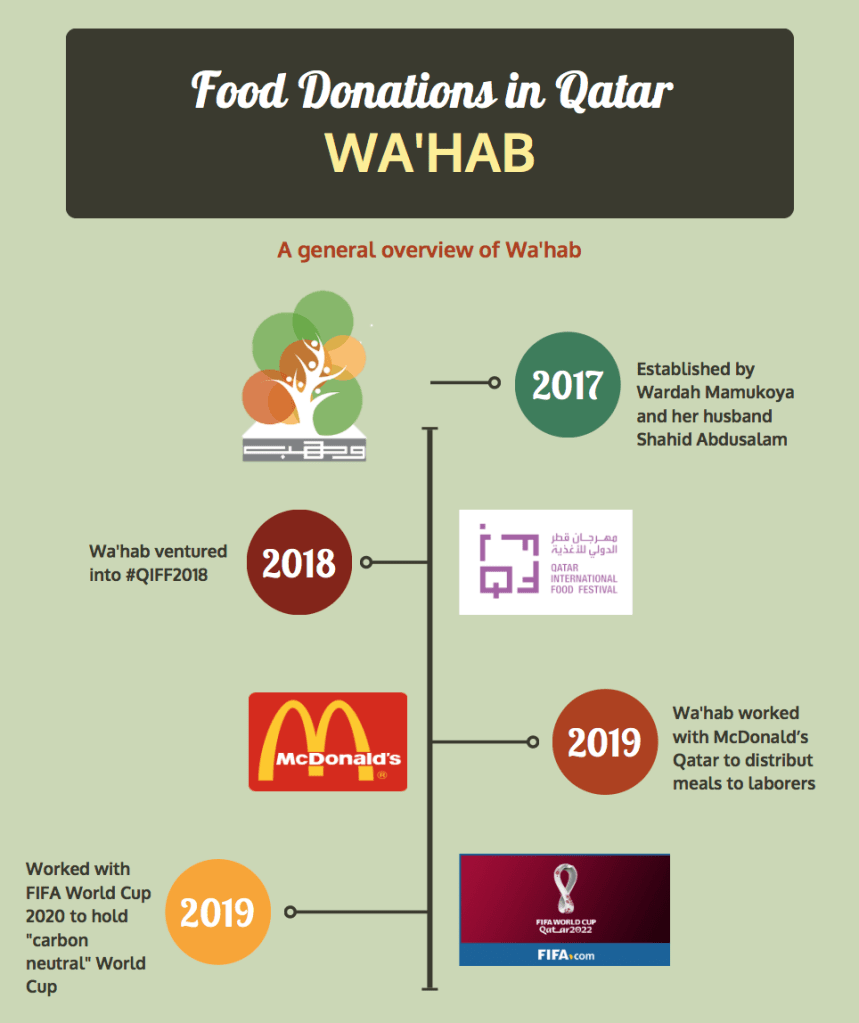
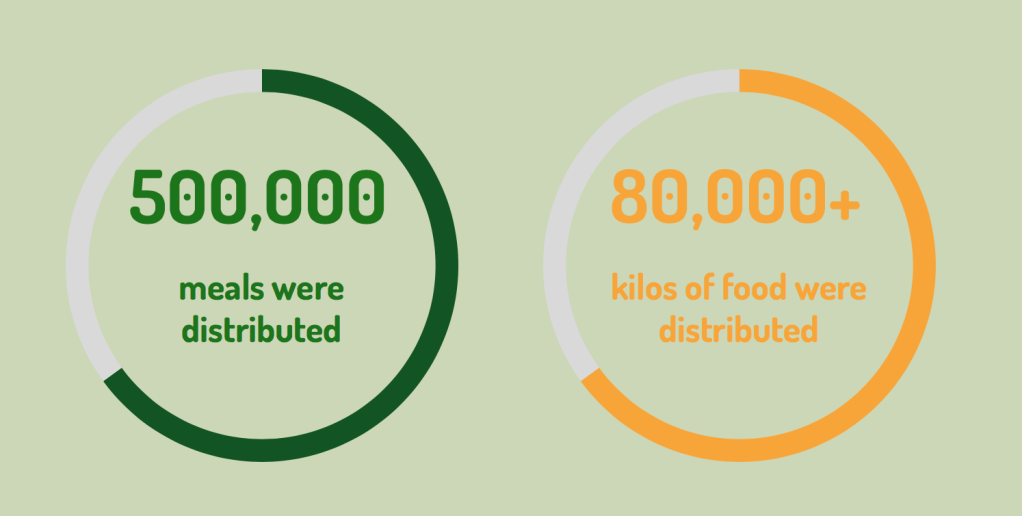
Social media and online communication materialized Wa’hab’s vision. Through propagating campaigns on Instagram and coordinating communication on WhatsApp, Wa’hab now has 25 active members and attracted more than 400 volunteers to help collect and distribute clean leftovers. The public reaches out to Wa’hab for food donations. Active members compile and post information in WhatsApp groups, and then contact volunteers for availability.
“So far, this social media coordination method has gone smoothly. But we recognize that we must create our own communication platform as our community is getting bigger and requires a more efficient way of coordination,” said Wardah Mamukoya, founder and managing director of Wa’hab.
The next move for Wa’hab is to establish a digital app that integrates big data and cloud technologies so that the distribution network can become more intelligent and efficient. “We have reached a stage that a Wa’hab app is under planning. With technologies, we envision a platform that is accessible to everyone and accurately connects willing people to needy people,” said Mamukoya. “We embrace all technologies that could strengthen the Wa’hab network, connect more people, and help us reduce the expenses,” she added.
Currently, the company operates primarily based on voluntariness. Even though Mamukoya categorizes Wa’hab as both a charity and private company, the charity identity has overshadowed the revenue side. Wa’hab has two main business models. One is logistics services — collecting and distributing clean surplus food. The other one is to sell food composting machines to ordinary households, companies, and restaurants. The wasted and non-edible food will be converted into high-quality Grade-A composts through fermentation, mechanical aeration, and Microbe technologies. Yet the later model encounters greater difficulties.
Mamukoya attributed the root problem for this difficulty to be people’s lack of awareness. “A lot of people waste their food because they do not calculate the value or have a careless attitude towards the price. If people could all recognize and make a conscious calculation, less food will be wasted from the roots,” Mamukoya said. While Wa’hab is addressing the waste problem at their best, people’s casual attitude is the elephant in the room. The company is also giving out lectures in universities to raise awareness towards a more conscious attitude towards food as well as environmental protection on a personal level.
“I found the awareness campaigns were helpful because it made me reflect on myself and felt ashamed of my past wastages. No one really has endless privileges over others,” said Amroo Haikal, 21, a university student who attended one of the lectures and has been a volunteer at Wa’hab. “Especially in our [privileged] community, taking the initiative to care about prices may make that person look mean. There is a cultural stereotype against it,” Haikal added.
Nevertheless, Wa’hab has paved an ideal way for conquering food wastages. Technologies are its weapon, equipping them with the ability to source, track, and make the best use of wastes. Future technological advancements will surely accelerate its growth and engage more people to join the team. After all, everyone has a stake in combating the deteriorating environment. Reducing one’s own food waste may be the first step.
Sources:
https://www.gulf-times.com/story/648029/Paving-the-way-by-reducing-food-waste
http://www.rfi.fr/en/middle-east/20170430-wahabtackling-food-waste-qatar
 talkk.tech.blog