Categories
-

Which streaming service is worth it at its price – in Qatar?

Watching movies and TV shows is that one moment in your day where your mind is finally being quenched with imagination, wonder and excitement. It connects you with people and their stories. This is why streaming services are all around us – to commercialize our need for entertainment and connection. 

Netflix. Hulu. Amazon Prime. Three of the most mainstream (no pun intended) channels for entertainment.

They are three great options to choose from when deciding where you should be shelling out money from your bank account each month. But, haven’t you asked yourself THE question? 

Am I paying for the best value of entertainment?

This breakdown will help answer that question for you!

NETFLIX

Price

A subscription plan with Netflix costs a monthly $8.99, $12.99 or $15.99 depending on which plan you choose. This price is actually a recently raised one. The plans used to cost $7.99 to $13.99 just last year, but it’s not clear why that is the case, because their library is still the same size.

Subscription Options

The main difference between the subscription plans is how many screens can play content at once, and the quality of the resolution. 

Basic plan – 1 screen, SD resolution 

Standard plan – 2 screens, HD resolution 

Premium plan – 4 screens, HD + Ultra HD resolution 

Content

This might be the biggest downfall of a Netflix subscription. As a Qatari resident, you have access to 178 TV shows and 552 movies. 

But if you were a US resident? You would get full access to all the content, including 1326 TV shows and 4339 movies in comparison. This is of course due to the differing rights of the content it streams. 

But no matter the reason, you’re paying the same price for approximately 1/7 of the content. Sound fair? 

Pro: You get Netflix’s original content. You don’t get original content in every streaming service. 

Ergonomics

The platform is easy to navigate through. The genres are categorized clearly. There is a list of content based off of the type of shows/movies you’ve watched and liked previously. You also get to preview content before playing it! 

Advertisements

Nope! Even with the basic plan subscription, no ads are found on Netflix. Yay!

HULU

Hulu is still geo-blocked in Qatar, but if you’ve found a way to work around that (*coughVPN cough*), then here’s a breakdown for you. 

Price 

A Hulu subscription will cost you $5.99, $7.99 or $11.99 per month depending on the plan you choose. 

Subscription Options 

Main different between the plans is the extent of content available and the ads interrupting your viewing or appearing as banners on the page. 

Basic – not all shows available, with ads  

Hulu Plus – all shows available, with ads

Hulu (no ads) – all shows available, without ads 

Possible Con? – All plans only allow one stream at a time. 

Content

Hulu recently expanded its library. It now has 1650 shows and 2500 movies. 

They are also buying the rights to certain series away from Netflix, which means Hulu is growing its library with content that is now exclusive to it – that can’t be watched anywhere else. Hulu is also planning to expand by licensing content for international markets and creating more original content in 2021! 

But, if being an international subscriber is not your issue – Hulu definitely has great content variety and at a great price – if you don’t mind the ads or want to shell out double the cash.

Pro: With Hulu, you get earlier access to just released content in comparison to other streaming services. 

Ergonomics

Hulu’s interface has always been debated by Hulu users as too confusing and difficult to navigate to be able to find the content they want to watch. The suggested content in the ‘Line up’ feature isn’t as personalized as the name suggests it to be, and is usually a hit or miss.  

But, Hulu has plans in the works to re-design its interface soon, and here are the details!

  • Replacing the ‘Line up’ option with ‘Hulu Picks’, which will allow Hulu more control over the landing page to display to you better viewing options. 
  • More content options will be added as you scroll down the page so all you need to do is check the thumbnail for what piques your interest. 
  • Even as you are searching for something you want to watch, you will still get options of different content options. 
  • You will be allowed to mark episodes as ‘watched’ or ‘unwatched’ in case you started your viewing somewhere else, and that way you can always pick up where you left off.
  • Details of the content, such as the year, genre, and rating will be added next to each one. 

Advertisements

This is really the biggest complaint from Hulu users. There are a lot of ads during your experience in searching for and watching their content. And unless you’re comfortable paying twice as much for no ads, there’s no avoiding it.

AMAZON PRIME VIDEO

Price & Subscription Options 

There is only one subscription plan with Amazon Prime Video. It costs $12.99 per month, in 4k HD quality, allows 3 streams, and gives you additional access to prime shipping, Amazon music and Amazon kindle.

Content

Amazon Prime’s library has 40,000 movies and TV shows to stream in total.

But, here’s the downfall. According to its users, most of the content found are old movies, B-movies, and arthouse films. They are outdated, and even when new content is added on there, it takes a lot of time. If you want newer shows or movies, you have to rent or buy them – outside of your subscription. 

Also, not as much original productions here.  

Ergonomics

You can only access Amazon Video from the main Amazon homepage, from a drop down menu at the top – definitely not the sleekest way to access your subscribed media. 

But when you do get to Amazon’s Prime Video interface, the content is categorized according to genre and thumbnails of different titles can be seen down the page. 

The biggest drawback has to be that it’s an actual exercise to search for a title. When you do, the options that come up don’t all fit under your subscription, a lot of them will be for rent/purchase. And so you have to look carefully to find what is free. 

Advertisements

Just like Netflix, no ads here!

The Showdown

NetflixHuluAmazon Prime Video
Price$8.99 – $15.99$5.99 – $11.99$12.99
Content178 shows, 552 moviesNew releases, only if licensed internationally 1650 shows, 2500 moviesQuicker upload of releases, but can’t currently access yet without VPN. 40000 movies and showsOutdated content, most exciting is for rent/purchase
ErgonomicsSleek, easy to use interfaceSatisfactory, exciting changes to come soonSatisfactory, but searching up titles is confusing 
AdvertisementsNoYes*No = double cost of basic plan No

Conclusion

It all boils down to this – How much are you prepared to spend from your income each month? If you’re someone who’s willing to spend somewhere between what Netflix’s basic and premium plans cost, why not go for Hulu once it’s accessible internationally in 2021? You’ll have a bigger variety of content at a cheaper price (assuming once its available, all content will be accessible). That’s what I would do! 

But it’s up to you – which one is the most worth it at its price, to you? 

Categories
-

Your Smart Home Devices Are Putting You at Risk

The range and scope of smart home devices continues to grow. Smart devices have taken over giphyhomes, offices and schools all over the world. Maybe you’re using the occasional home assistant like Amazon’s Alexa or Google’s Home or even, Siri on your iPhone. Perhaps, instead of using a key to enter your office or home, you are required to enter a code on your smart lock. Smart devices have become mainstream and everyone is in search of the next gadget that will allow them to control locks, lights and even refrigerators, from their phone. However, there are some risks associated with these devices and ways to protect yourself. Here are some:


Hacking into security camera

wyze-3 (1)In 2019, a video of a young girl speaking to a voice coming from inside her room went viral. In the video, a man tells the girl from a speaker that he is Santa Claus and encourages her to misbehave. The video is from the family’s Ring security camera that was installed in the 8-year old’s bedroom a few days before the incident. The man had taken advantage of Rings two-way talk function. Across the United States, incidents like this one have become increasingly common.

Al-Harib Security Systems, a security solution company in Qatar that offers smart home solutions, suggests that you secure the network you are connected to. They suggest that you change the username and password given to you by your internet provider and after, regularly change your password.

Police surveillance

giphy (1)In 2019, The Washington Post reported that Amazon’s home security company, Ring, is in partnership with more than 600 police departments in the United States. These partnerships allow the police to “quickly request and download” video recording from home owners Ring devices. However, many people have expressed discomfort in law enforcement possibly confiscating recording of them for cases. The Washington Post reported a large issue arises when law enforcement can keep footage and share it without providing evidence that there has been a crime. Experts suggest that check with your smart home security provider if they are working with law enforcement or a third party and what terms they have in place.


Information on home assistants

Smart home assistants have widely been popular over the last few years. They have been designed to make your life easier, by assisting you in making calls, getting your news and even ordering food. Your home assistant holds very valuable and sensitive information about you, your family and your friends. If your home assistant is accessed, hackers can get information from numbers of your phone to your credit card information.

Experts suggest that you update your devices as regularly. Manufactures regularly make updates after identifying a security issue and you need to ensure that your home assistant is up-to-date. Most importantly, learn more about what your home assistant has access to and what it can do so you can perhaps limit that access or go for another home assistant.


Categories
-

Qatar Central Bank Launches “Sandbox” Technology

By: Mohammed El-edrisi

The wait for the “sandbox” technology is finally over. After the Governor of Qatar Central Bank HE Sheikh Abdullah bin Saoud Al-Thani first announced the launching of a “new platform to support Fintech” back in October 2018 at Carnegie Mellon University in Qatar, the platform is now done and has been officially launched on Wednesday February 12, 2020.     

His Excellency Sheikh Abdullah bin Saud Al Thani, Governor of the Central Bank of Qatar, said that the Central Bank, representing the supervisory and supervisory body for the financial sector, is fully aware of the importance of financial technology in the development of the banking and financial sector in the state, and from this logic, and within the framework of the Qatar National Vision 2030, have decided to launch this platform.

The “Sandbox” technology for computer security was launched as a part of QCB’s preparations to reveal its Financial Technology (Fintech) strategy.

In his opening speech during the ‘Qatar-UK Financial Services Event’ held Wednesday in Doha, HE the Governor of Qatar Central Bank (QCB) Sheikh Abdulla bin Saoud al-Thani said Sandbox “we are going to pave the way for a new generation of financial services in the state of Qatar, as part of the upcoming financial inclusion strategy, which will be launched soon on an official state level.” Sandbox technology is for computer security that separates running programs and malware.

The Mayor of the City of London “Alderman William Russell” was among the high profile individuals who were present during the QCB governors speech and announcement.

The QCB governor also focused on talking about the strong connection and coalition between Qatar and the UK in the field of cybersecurity and the financial sector. He also emphasized how he’s proud of the ties between both countries and how he has seen a huge development in the last decade. He then went on to drift away from the financial and technology sectors to speak about how the ties between both countries isn’t limited to that but also extends to an important sector, which is the education sector.

Sheikh Abdullah announced that the Uk and Qatar have agreed to build the Qatar Centre for International Finance and Banking, describing how it will be a blueprint for growing human capital and to helping grow and develop education and training in the field of finance.

He said the agreement will help achieve the goals of Qatar National Vision 2030, and the strategy of the financial sector in the state of Qatar, especially to human resource development.

According to Sheikh Abdulla, the ‘Qatar-UK Financial Services Event’ the topics during the forum are related to regulating Fintech and the role it plays in promoting the role of small and medium-sized enterprises (SMEs) in society.

In an interview with the Gulf Times, the UK ambassador to Qatar Ajay Sharma expressed how the staging of the ‘Qatar-UK Financial Services Event’ is a follow up to the success of a previous cooperative event held last year in London by the name of “Qatar Day” which was made to strengthen the long-term relationship between Qatar and UK.

Sharma also emphasized the importance of building strategic partnerships as the UK looks forward to the creation of an advanced financial service centre in Qatar that helps achieve the goals the country is trying to achieve for Qatar National Vision 2030. 

Categories
-

What is Multi Level Marketing and why are many Doha residents hopping onto this trend?

By: Mohamed Eledrisi

What is a pyramid scheme? Is the business opportunity you’ve been offered real or a scam?

You wake up one day and you make your way to your university, gym session, or your job. You get a phone call from a friend telling you about this online business and how it makes you some real nice extra income. He doesn’t want to give away too much about the business so he tells you to meet him at a coffee shop so he can show you the “business presentation”.

The scenario you’ve just read is how multi-level marketers get in contact with their friends in order to recruit them to work with their companies. But is this “business presentation” you’re going to listen to, a scam? Or is it real? In order to answer this question, we must first rewind back in history and see where the word “Pyramid Scheme” or “Ponzi Scheme” came from and figure out what it means. 

The term Ponzi Scheme was named after Italian swindler Charles Ponzi. He was a big scammer in Italy in the 1920’s and was going to be thrown in jail for his actions. He then realized it was dangerous to stay in Italy, and made his way to North America. He roamed the US for a while, going from city to city, till he ended up north in Montreal, Canada. He worked for an Italian bank in Montreal and slowly went back to his old ways and tried to forge signatures to get access to money and cheques. He eventually got caught and thrown in jail for 3 years, before deciding to later move back to the US where he found the key to his financial freedom. 

Charles Ponzi came up with a fraudulent investing scam promising high rates of return with little risk to investors. This fraudulent scheme ends up  generating returns for early investors by obtaining new investors. So the whole scheme is based on using new investors’ funds to pay the earlier investors, meaning if people stop investing, the scheme will collapse.

Multi Level Marketing is a “business model or marketing strategy in which the distributors’ income includes their own sales, and a percentage of the sales group they recruit, which is commonly known as their ‘downline’. Customers can also sign up as a distributor to sell the company’s product”

A pyramid scheme is a business model that recruits members via a promise of payments or services for enrolling others into the scheme, rather than supplying investments or sale of products. As recruiting multiplies, recruiting becomes quickly impossible, and most members are unable to profit; as such, pyramid schemes are unsustainable and often illegal. 

Our techtalk team came up with a list of questions to help you figure out if the business opportunity you are being presented with is a scam or worth taking.

  1. Has the company been around for more than 7 years?

Over the years it has been harder and harder for pyramid schemes to last for a long period of time, especially since they have been banned in many countries around the world such as the US and the UK. The 7 year mark in the world of business always proves that a company has bypassed all legal and technical issues and is an important factor in proving whether a company is a pyramid scheme or not.

  1. Is the majority of your income coming from recruiting people, or is the main source of income based on an actual service/product?

Any pyramid scheme company depends on recruitment as its main source of profit. The product that the company provides, is at many times considered an “imaginary” product, meaning that the real cash flow of the company is not through the product or service being sold but instead literally just through people joining or “new investors”. This is the main reason why pyramid scheme companies end up going bankrupt or disappearing. 

     3) What country is the business you’re being offered based in? 

The reason this question is so important is because as mentioned before, pyramid schemes are illegal in many countries around the world. So for example if you were provided with a business opportunity from a company based in the US, and the company is a public trade US company, this would mean that it’s being monitored by the Federal Trade Commission and Security Exchange Commission. In simpler terms, this means that the company is being watched by the government and would totally get shut down if it didn’t comply with these government regulations.

In conclusion, there are real Network Marketing/E-Commerce businesses running in Qatar that you could make real extra income from. Statistics tell us that most people that do join these companies don’t achieve financial freedom or being “rich” but a good sum of people do make a stable income through these opportunities. Make sure to do your research before taking any business opportunity, and always ask people who have been through the experience beforehand.

Categories
-

To Social Media Or Not To Social Media? Which Side Are You On?

So far people have done well hyping up the issues of social media without mentioning the benefits. Nowadays, people are digitally entangled in one way or another. Social media sites are now a gateway to the lives of those who choose to use it. For this article, we gathered some answers from a study that looked into the top ten reasons why we use social networks and compared it to some of our own. Therefore, let us look at people’s social media habits and experiences and see what they have to say on the matter.

Habits and Experiences

Amna Al Hammadi enjoys surfing Instagram and Snapchat. “I like to post about my daily life and enjoy seeing what others are up to as well,” she said. Amna’s favorite social media habits are viewing, liking, and commenting on other people’s posts. 

Hessa Al-Attiya, on the other hand, likes to be more specific when sharing about her day. “I like to let people in on what I’m doing at times. Like if I’m drinking tea or at the mall hanging out,” she said. However, when Hessa is not enlightening her followers on the benefits of tea, she is bouncing from one social media platform to the next to pass the time. “It allows me to escape boredom,” she said. Similarly, 39 percent said they use social media to fill up spare time, which is the third reason on the list, according to the study. Out of all the popular social sites, Twitter is the one Hessa is drawn to the most. “I have a “secret” account where I can speak freely and complain about stuff without family members knowing,” she revealed. 30 percent said they use social media to share their opinion, which ranks at number eight on the list, as stated by the study.

Advantages

Amna mainly uses social media to stay connected with friends and family. “It keeps me updated with what is going on in the world and in people’s lives,” she said. Like Amna, Hessa is also hoping it will bring her closer to those who are not around her. “It helps me connect with my friends and family, not to mention celebrities, to see what they are up to,” she remarked. According to the study, it is the number one reason on the list with 42 percent saying they use it to stay in touch with what friends are doing.

Amna finds less visual media-oriented apps like WhatsApp advantageous as it speeds up communication, which is why she added the app to her social media repertoire. “Not that you can’t do that on Instagram and snapchat,” she said. “I just appreciate the convenience of not having to get distracted by content people post.”

Sharing something about yourself and your journey on social media can be a fulfilling experience, Amna said, which corresponds with reason number seven, with 32 percent respondents saying they use it to share photos or videos with others. According to Amna, “giving out nice comments to people encourages them be confident about themselves, especially if they decide to post selfies.”

Disadvantages

Of course, we cannot conclude without touching upon the negative aspect of social media. Although for many people online, staying in cyberspace makes for a better reality, Amna admits social media can have its drawbacks. “It is addictive and there are a lot of people out there who can be rude,” she said. Like with all good things, social media can be misused. For example, Amna believes that cyberbullying is an issue on social networks that might seriously affect someone’s life. “Posting negative comments about a person’s appearance could lower their self-schema, self-love, and self-confidence,” she said. “Which ultimately could lead to depression or even suicide.”

A person could connect with others on social media platforms with just a click of a button, but they would end up disconnecting with the ones who are right beside them. Hessa dislikes the fact that social media is pulling her away from her family. “The worst part about it would have to be getting distracted when I’m sitting with family or even “trying” to do homework,” she admitted. “I feel the need to check my social media.”

Categories
Science

Decoding 5G: promises, challenges and the environment

The next big thing in networking and communication, 5G has seen rapid growth in recent years. But what is it, how does it work? And how will it impact the world around us? Watch the video below to learn more.

Categories
-

Tackle Food Wastes: Feed Stomachs Not Landfills

Your unwanted food may be other’s craving. This start-up sends your surplus food to the starving vulnerable.

While Qatar is ranked as one of the fastest-growing economies, it has the highest per capita waste generation not only in the Gulf region, but also worldwide. According to EcoMENA, the country produces 1.8 kilograms of waste per capita every day, and the predominant method of resolving these wastes is through disposing them into landfills. Landfills only storage the wastes. Greenhouse gases surface emissions from landfills, which worsens Qatar’s environmental problem and long-term sustainability. Therefore, a better method to manage wastes in Qatar is in dire need. 

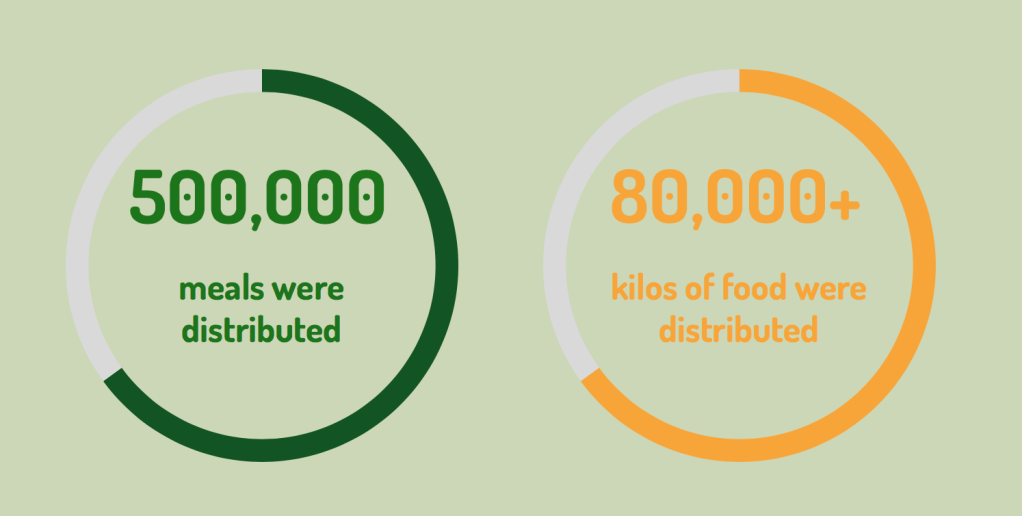
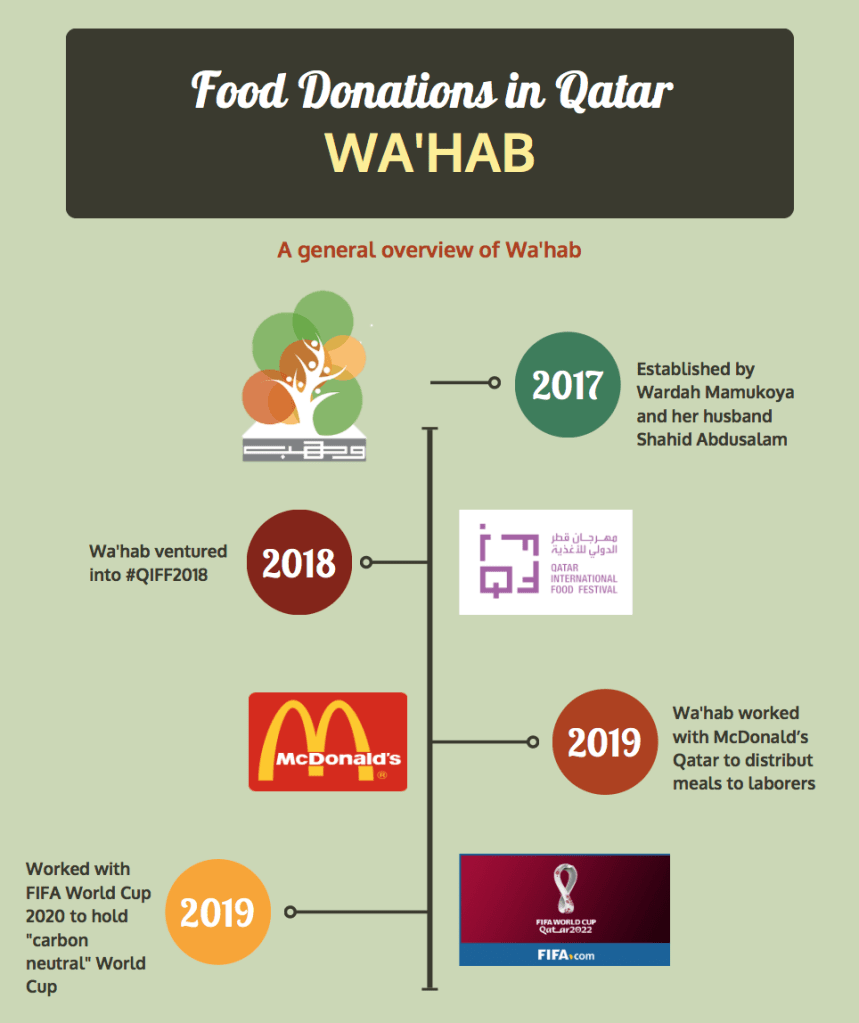
Striving to “feed people, not landfills,” Wa’hab is a Qatari start-up that takes the challenge. Founded in 2017, Wa’hab started as a charity platform that collects and distributes surplus food to needy people. Allowing people to consume the untouched surplus food is a win-win strategy as it fills people’s bellies and prevents food from going into landfills. The start-up relies on networks with public institutions as well as personal connections to seek surplus food from lavish buffets, weddings, and public events. Then it will arrange logistics to give the food to the vulnerable population. 

Social media and online communication materialized Wa’hab’s vision. Through propagating campaigns on Instagram and coordinating communication on WhatsApp, Wa’hab now has 25 active members and attracted more than 400 volunteers to help collect and distribute clean leftovers. The public reaches out to Wa’hab for food donations. Active members compile and post information in WhatsApp groups, and then contact volunteers for availability. 

“So far, this social media coordination method has gone smoothly. But we recognize that we must create our own communication platform as our community is getting bigger and requires a more efficient way of coordination,” said Wardah Mamukoya, founder and managing director of Wa’hab. 

The next move for Wa’hab is to establish a digital app that integrates big data and cloud technologies so that the distribution network can become more intelligent and efficient. “We have reached a stage that a Wa’hab app is under planning. With technologies, we envision a platform that is accessible to everyone and accurately connects willing people to needy people,” said Mamukoya. “We embrace all technologies that could strengthen the Wa’hab network, connect more people, and help us reduce the expenses,” she added. 

Currently, the company operates primarily based on voluntariness. Even though Mamukoya categorizes Wa’hab as both a charity and private company, the charity identity has overshadowed the revenue side. Wa’hab has two main business models. One is logistics services — collecting and distributing clean surplus food. The other one is to sell food composting machines to ordinary households, companies, and restaurants. The wasted and non-edible food will be converted into high-quality Grade-A composts through fermentation, mechanical aeration, and Microbe technologies. Yet the later model encounters greater difficulties. 

Mamukoya attributed the root problem for this difficulty to be people’s lack of awareness. “A lot of people waste their food because they do not calculate the value or have a careless attitude towards the price. If people could all recognize and make a conscious calculation, less food will be wasted from the roots,” Mamukoya said. While Wa’hab is addressing the waste problem at their best, people’s casual attitude is the elephant in the room. The company is also giving out lectures in universities to raise awareness towards a more conscious attitude towards food as well as environmental protection on a personal level. 

“I found the awareness campaigns were helpful because it made me reflect on myself and felt ashamed of my past wastages. No one really has endless privileges over others,” said Amroo Haikal, 21, a university student who attended one of the lectures and has been a volunteer at Wa’hab. “Especially in our [privileged] community, taking the initiative to care about prices may make that person look mean. There is a cultural stereotype against it,” Haikal added. 

Nevertheless, Wa’hab has paved an ideal way for conquering food wastages. Technologies are its weapon, equipping them with the ability to source, track, and make the best use of wastes. Future technological advancements will surely accelerate its growth and engage more people to join the team. After all, everyone has a stake in combating the deteriorating environment. Reducing one’s own food waste may be the first step.   

Sources:

https://www.gulf-times.com/story/648029/Paving-the-way-by-reducing-food-waste

http://www.rfi.fr/en/middle-east/20170430-wahabtackling-food-waste-qatar

http://www.dohafamily.com/Winter-2018/Waste-Not-Want-Not-Wahabs-Solution-to-Conquering-Food-Waste-in-Qatar/

https://www.wahab.qa/about

Categories
-

Social media is secularizing #halal, data shows

As a vegan influencer based in Qatar, Ghanim Al-Sulaiti does not see the word #halal popup or used in his social media feed and he does not use it on his posts on a daily basis. To him, it is the religious notion relating to the slaughtering of animals, which he does not support and does not engage in. In fact, he opposes the notion entirely, as he believes that no animal can actually be slaughtered with no pain as the technique is believed to do.

However, the use of #halal is drastically changing online based on a data study done by the Qatar Computing Research Institute. It is no longer just a religious notion. Based on the results, #halal can be assumed to be evolving into a lifestyle and is becoming highly commercialized and secularized, which could be used to target a growing millennial Muslim population.

“We can see it already in the data…there are all these social media websites that are making money on promoted content, which is explicitly labeled. But there are also all these influencers who are paid to promote content while not looking like an ad,” said Yelena Mejova, lead author of the study.

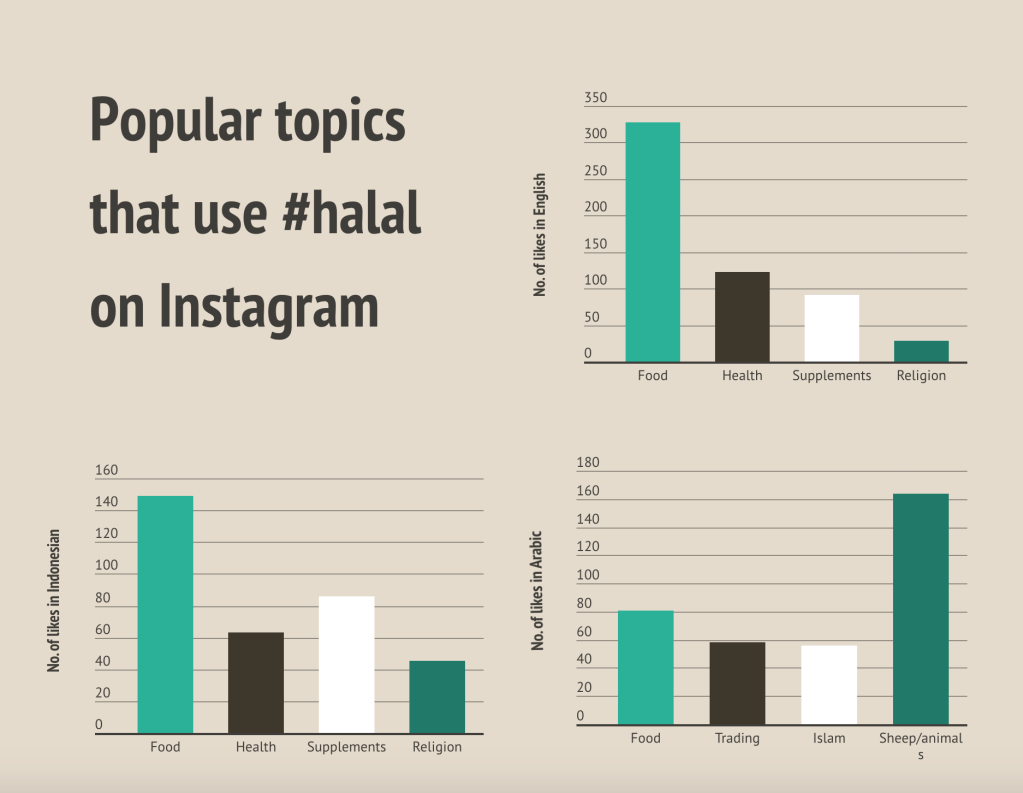
The study analyzed two Instagram datasets, using Halal in Arabic (325,665 posts) and in English (1,004,445 posts), which provide a global view of major Muslim populations around the world. A great variety is found in the use of halal within Arabic, English, and Indonesian-speaking populations. Animal trade makes up 61 percent of the language stream, food is second with 80 percent, and cosmetics and supplements are third with 70 percent.

Link to interactive graph: https://infogram.com/d94dd373-e937-4be5-a5e0-a88f1eaa277b

The commercialization of the term halal is a powerful signal of its shift from its traditional roots. Posts mentioning religious terms, such that when a food-related post is accompanied by a religious term, it on average gets more likes in English and Indonesian, but not in Arabic, indicating a potential shift out of its traditional moral framing, according to the study.

Currently, Muslims have the youngest median age (23 in 2010) of all major religious groups, 7 years younger than the median age of non-Muslims. The Pew Research Center projects the Muslim population will grow more than twice as fast as the overall world population between 2010 and 2050, likely surpassing Christians as the world’s largest religious group. As the generation of Muslim millennials asserts itself in the webspace, it brings its culture to the world’s social media stage, potentially redefining its traditions.

The commercialization of halal is characterized by food posts on Instagram

Comprising more than a billion of the world’s population, Muslims represent an important market segment—one which unites under the practice of halal—yet, it is largely considered marginalized in Western mainstream marketing.

However, new marketing approaches to this new generation of Muslims extend its application beyond diet, emphasizing a whole halal lifestyle, which is maintained not only in practice but also in philosophy. As corporations aggressively label their products as halal, it becomes increasingly important to understand the definition of halal by the new generation of consumers and their relationship to old and new authorities on the matter.

Influencer-like posts dominate the narrative around halal online

“Halal refers to actions and deeds that are permissible [in Islam],” said Ibrahim Abusharif, a scholar of media and religion, and journalism professor at Northwestern University in Qatar. “And I think people today tend to be lazier. They’re just looking for labels… digital media is deluding religious authority. And so what people say means following them no matter what.”

In Arabic, religious keywords decrease the average likes from 168 to 144, showing the shifting social engagement with religious authority. The most prolific users, in all three languages, are the commercial entities selling sheep and animals in the case of Arabic, food, and supplements in English and Indonesian. However, the likes bring out different users, with the most liked posts generated by celebrities. The top 10 Arabic accounts include humorous accounts and those of actors and political commentators.

The study further found the definition of halal extended beyond food, as a part of an identity. Throughout the data, they found examples of posts that received thousands of likes, for instance, promoting a “halal” fashion show, “halal” fitness culture, a “halal” movie, and other lifestyle posts emphasizing clothes and stylish surroundings. The visual appeal of the content was also paramount.

A halal lifestyle was emphasized by aesthetic fashion posts

“[However], if your post is liked a few billion times, it doesn’t make it right,” added Abusharif. Marketing is about profit, it is not about ethics and truth, according to Abusharif. If it’s something sells, you’re going to go for it, whether it’s right or wrong, whether it’s fully truthful or not.

In the marketplace of ideas, what sells is paramount. “[Marketers] would kind of zoom in to the wording that is more likely to keep the customers right. That is more likely to, you know, for people to like. The market will encourage people to use words or concepts that are more likely to result in profits,” added Mejova

However, for Al-Sulaiti, this trend is due to a lack of education. “We can’t say, look, it’s a trend if the trend is working, but the trend is working because these people who they are targeting are not educated,” he said.

Categories
-

The Battle of Wireless Earphones

Have you ever considered buying an earphone but there are just so many earphones in the market? It is hard to find the perfect earphone without testing them. In this video, Tech Talk reporter Asmaa Al-Sulaiti had people test the products: Aipods Pro, Powerbeats Pro, Bose Frame and Bose Soundssport and gave a comprehensive video review.

This video details the specs of the four types of wireless earphones, and allows you to get an insight into the many features they have. All of the wireless earphones shown in the video are available in Qatar.

Bose Frames: Retails for QR949 in Virgin Megastore

Bose Soundssport: Retails for QR899 in Vigin Megastore

Powerbeats Pr: Retails for QR1109 in Virgin Megastore

AirPods Pro: Retails for: QR999 in Virgin Megastore

Categories
Innovation

QPay New Technological Payment Initiative in Doha

Many small shops and vendors around Doha do not have technological payment tools such as paying through card or smart phones. The lack of these payment tools does not only give a hard time for customers who might not have cash on them while shopping but also is very inefficient to track payments and workers’ salaries who sometimes don’t get their wages for months. In this podcast, I talk to Zuhair Mohammad, a product lead at QPay, Qatar’s Largest Financial Technology Services Network for Small & Med-Size Enterprises. Zuhair will tell us how QPay is trying to provide new technological tools and services for small vendors in order to solve many of the payment problems startups owners face in their business. 

Podcast by Ayman Ali
Point of Sales (POS) machine described in the audio
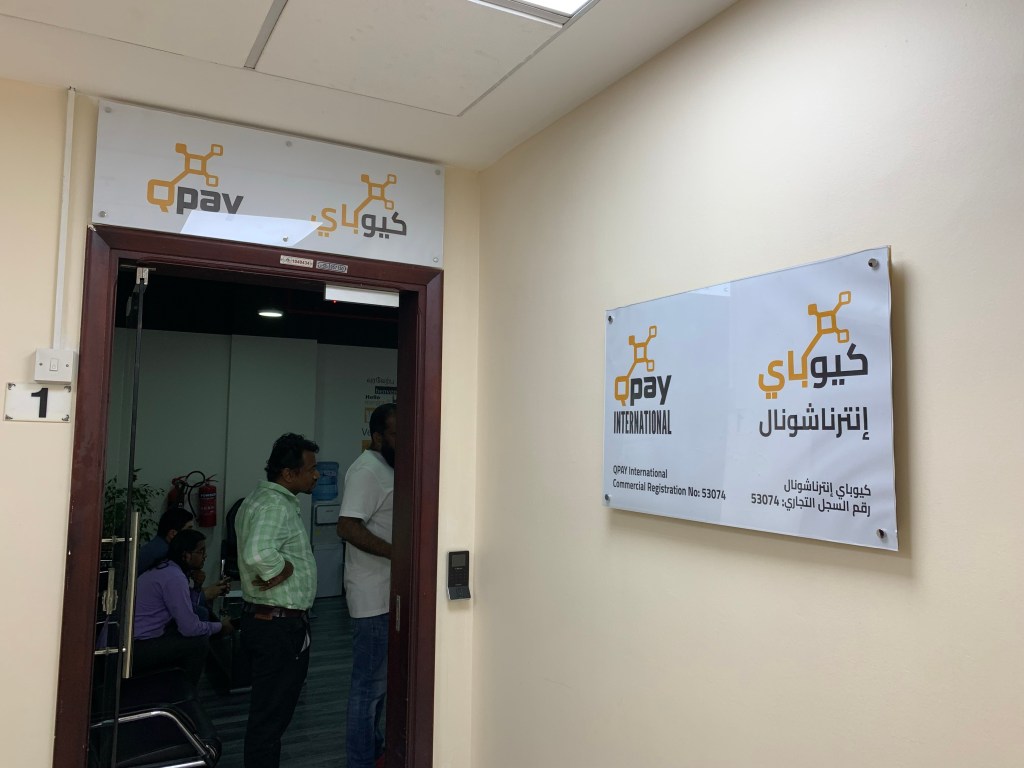
QPay’s office is located in Grand Hamad Service Street next to Souq Waqif parking lots
QPay’s customer service office
Design a site like this with WordPress.com
Get started