Feeling lost about a current event is never a great feeling. Follow me in this short explainer on Esports to understand the gist of the sport – just in time for the Wega Global Games tournaments in Qatar! You can also find out how to be a couch-potato-athlete since Esports have completely transcended our perception of what counts as a sport.
So next time someone asks you to “find your sport,” you can just press your computer’s power button.
The new model of the MacBook Pro offers great improvements in performance and ergonomics, but the question remains, do the improvements justify its price tag?
Find out whether it’s worth it for you to upgrade your current laptop to the new Macbook Pro 16’ inch!
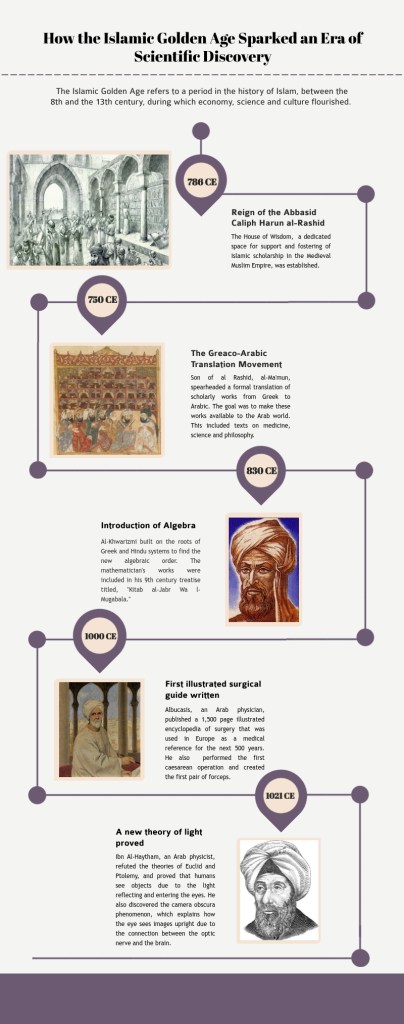
In this episode of Let’s Tech Talk, we challenge the perception that science is a western endeavor, and explore the role of the Arab world in bringing about the European Renaissance. We are joined by Anto Mohsin, assistant professor at Northwestern University in Qatar.
Have you ever considered buying a scooter? In this video, Tech Talk reporter Dylan Finol does a comprehensive video review on the Xiaomi Mi Electric Scooter and compares it to the Oxelo Town 5XL scooter.
This video goes into detail on the specs of the two types of scooter, and allows you to get an insight into the many features both scooters have. Both the electric and traditional kick scooter are available for purchase in Qatar.
Oxelo Town Scooter: Available at Decathlon in Vilagio Mall for 399 QAR
Xiaomi Mi Electric Scooter: Available at HMV in Mirqab Mall for 1,699 QAR
Faculty members at Carnegie Mellon University in Qatar are leading a new research project funded by Qatar National Research Fund (QNRF) to create an interactive map of Qatari dialect.
The project plans to explore the geographical, historical, and social variation of the country’s dialect. It will incorporate interactive tools that will allow educators and Arabic-speaking learners to navigate through the different pronunciations, usages, and terminologies of the Qatari dialect.
The research team consists of two leading CMU-Q faculty members. Zeinab Ibrahim, teaching professor of Arabic studies, is the lead principal investigator on the project. CMU-Q’s assistant professor of information systems, Houda Bouamor, is a principal investigator on the project.
Why this project?
Recently, Qatar’s heritage has been undermined by the unprecedent development and modernization in the country. The initiative aims to gather all the scattered academic and historic information about Qatar’s dialect and use it as reference for future generations. More importantly, Arabic teachers could utilize such tool to help Qatari students learn modern standard Arabic.
How did it start?
Professor Bouamor is a computational linguist and a computer scientist that has been working on Multi-Arabic Dialect Applications and Resources project. The research, called MANAR and funded by QNRF, covered 25 cities of Arabic dialects in the region.
“Dr. Zainab called me and told me ‘you have worked on this big project, what if you if you want to focus on Qatar only?’” said Bouamor.
What are the utilities?
According to her, the map will show two main branches of the Qatari dialect, both nomadic and urban. Tools will also classify dialects into micro-categories based on the person’s education level, social background, and place of origin.
“It will also be a gender map, where we will show how Qatari girls speak differently from their male peers,” said Bouamor. The team will build resources that are parallel between speech and text and use natural language processes through artificial intelligence.
According to Bouamor, the computational team will program the website by incorporating initial sources such as interviews, research papers, social media posts, and standard Arabic TV channels. This will allow the tool to make comparisons through machine learning system based on digital algorithms and inputs.
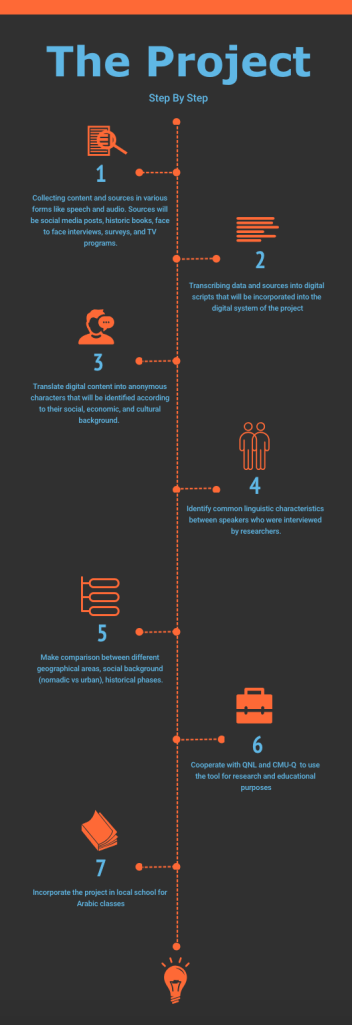
Steps of the project:
Collecting content and sources in various forms like speech and audio. Sources will be social media posts, historic books, face to face interviews, surveys, and TV programs.
Transcribing data and sources into digital scripts that will be incorporated into the digital system of the project.
Identify common linguistic characteristics between speakers who were interviewed by researchers.
Make comparison between different geographical areas, social background (nomadic vs urban), historical phases.
Cooperate with QNL and CMU-Q to use the tool for research and educational purposes.
Incorporate the project in local school for Arabic classes.
The government going after dark websites is not the best solution to eliminate buying illicit materials online
The dark web provides an open environment for buying and selling illicit drugs
The use of Tor Browser is not as easy as many people may think
The Tor browser or Deep Web is a clandestine web that gives access to vendors and buyers to trade illicit materials online without having to make physical contact. While it eliminates direct and physical contact and provides security protection between buyers and sellers of illicit materials, it is not easy to access this website. It requires technical-know-how to access it.
Here are six things I learned from a talk on Deep Web held at Carnegie Mellon University by Prof. Nicolas Christin on Jan. 19, 2020.
Online is the new black market
“A deep dive in the deep web” became prominent in the early 2000s. Previously, if you wanted to buy illicit materials, you usually go through a friend who knew a friend, however, that has changed with the coming into being of online buying and selling, said Nicolas Christin a lecturer at Carnegie Mellon University. On the issues that influence his decision to explore the dark web was based on a purely emotional statement. “The world is coming to an end because people are selling drugs online, and I’m a scientist. I don’t like to be presented with emotional content,” he said.
The government should chase the seller, not the product
The original strategy for law enforcement officers was to try to take down marketplaces but that has changed. “It does not work because a marketplace is a natural Web site and a database that’s very easy for a technically inclined person to set that up in a couple of hours,” he added. Instead what is most effective in combating these illegal online selling, is to go after vendors, “it’s a lot harder to replace if you are a big drug kingpin who has access to lots of physical products and you end up in prison, it’s going to take time for somebody else to replace,” Christin said.
What students currently know about the Tor browser
Before the presentation, myself and many students, were not knowledgeable about the dark web. “I don’t even know how to access these services and this guy scroll the whole web looking for this Web site makes it very interesting, so, it was interesting to see a breakdown of some of the dark Web sites,” said Muhammad Nurul Haque a senior at CMU-Q. In an attempt to learn about the dark web, I download the Tor Browser with the help of VPN. First, you need to quit all your internet apps and type “tor browser”. Once you instal tor browser, cover your laptop’s camera for security reason. What I learned, there are many stages and some of them require payment to get access. The more you delve into the dark web, the more complicated it becomes.
The same economic rule governs both legal and illicit materials in an online platform
Christin said, criminologists and economists have argued for years, the economic rules that apply for selling legal products are the same rule that governs the sales of cannabis and heroin in dark websites. However, what is fascinating to him scientists have a large copy of data that they can work with. “If you want to research in Criminology, if you want to figure out how much drugs are being sold, for instance, in the city of Pittsburgh today, it’s very hard to do because this is a completely hidden commerce, despite being a dark web, it’s completely in the open,” he added.
The best way to protect yourself is to learn as much as you can
As final advice to students Christin said, in an online adversarial environment, the use of most technologies is not something sinister. But you can also use it to “get all of those trackers, all of those tracking technologies off your back” when you’re browsing online so that the technology is working reasonably well for you instead of working against you, Christin added.
Can we buy illegal products in Qatar?
The talk did not discuss cases related to Qatar but you can do your own research as I did, though you should be cautious.
The increase in the number of sport facilities in Qatar has driven them to do anything and everything to stand out.
Integrating technology in working out has become attractive to consumers who would pay extra just to feel more engaged.
But does technology really contribute to a healthier lifestyle, or is just integrated for marketing purposes?
Remember that time as a kid when you would spend your lazy Saturdays on your consoles and tablets, scrolling through an endless list of games and apps, only for your mother to tell you off for spending too much time on them instead of going out and doing some physical activities. Well, mom, what if we told you that now, even during physical activities, people are still hooked on their gadgets thanks to the spike in technology-oriented sports facilities and fitness studios.
Here in Qatar, and frankly all around the world, gyms and fitness studios are opening at exponential rates. CrossFit studios, high-intensity interval training (HIIT) gyms, Pilates classes, etc. are spreading like wildfire across the relatively small country. Of course, the national attention and emphasis given to sports cannot be removed from the context of Qatar’s 2030 Vision, as well as the fact that in less than three years, Qatar will be hosting one of the grandest sporting events in the world; the 2022 FIFA World Cup.
For most of those new gyms, however, the issue is not to simply celebrate a fancy grand opening and then have all your customers bail on you after their free trails end, but rather it’s to stand out enough that you offer an experience that transcends mere physical exercise. No longer is going to the gym and just working out satisfactory for customers, instead, they expect to be entertained and engaged as if they were signed up to an amusement park and not a gym, and that’s when technology kicks in.
Many of the newly opened gyms in Qatar, such as Ox Fitness Lab, Encore, and Australian fitness brand, F45, have attracted attention to themselves by presenting themselves as the alternative and modernized way of working out. Such gyms are mobile-app based, and not only for the purposes of confirming bookings, completing payments, browsing for merchandise, etc., but even also for providing entire fitness and diet programs for the sake of the consumers’ convenience.
Also, these studios engage their customers in competitions and prizes that are based on their physical performance measured by gadgets like Fitbits and Apple Watches. For instance, each customer’s gadget would measure the number of calories they burned during the workout, and then the studio would record these numbers and give away prizes, such as meal plans and bonus classes, to those with the highest number at the end of the competition’s cycle
Customers signing up for F45’s 8 Week Diet Challenge
“It’s a mentality of connectiveness,” said Renato Marcus, senior trainer at F45’s Education City branch, “The apps and the other technologies help people book classes together, compete together. It’s like our own inclusive sports family.”
In fact, the case of Education City’s F45 studio is particularly interesting because within Education City, there are numerous sports facilities provided for students that are free of charge, yet many students are switching allegiances to F45, despite its pricy rates. It is true that the studio provides significant discounts for students, but the discounted prices are still hundreds and thousands of riyals more expensive than what is literally free.
But to assume that technology on its own is a sufficient driving force to get people to opt for more expensive gyms rather than traditional gyms that are free of charge – I repeat: FREE OF CHARGE – is somewhat of a stretch.
“It’s like the best of both worlds,” said Ali Al-Thani, an Education City student who switched from the free gyms to F45, “you get the physical exercise needed but also you feel excited when you work out.”
What the integration of technology in sports facilities does is that it amps up the engagement level of those exercising and makes them always alert and active during their workouts, which ultimately has health benefits. If customers knew that there was a pot of gold made of bonus classes and merchandise at the end of the rainbow that is exercising, they would most likely step up their game in order to claim those prizes, and that undoubtedly is a health benefit regardless of winning the prizes or not. And adding to the health benefits technology contributes to, the screens in these gyms that display the proper form of a specific exercises help prevent those exercising from sustaining injuries caused improper exercise form.
The integration of technology in sports was an eventual step in the current digital age. We are so reliant on technology in our everyday lives, whether for texting friends, ordering groceries, figuring out whether your boyfriend is great or just a racoon (actual BuzzFeed quiz…). And so, to see technology takeover its antithesis, which is physical exercise, is almost ironic, but it was pretty much inevitable.
“The digitalization of sports is almost a reflection of our media consumption,” said Róisín O’Shea, head of business development at StubHub’s UK office, “Sports facilities are trying to attract you through keeping you in your comfort zone.”
Not only that, but considering the significant global spike in health awareness, it has become ‘trendy’ to be active, which means eating healthier, exercising on regular basis, making sure to tell all your friends who aren’t exercising that they’re lifestyles are fundamentally wrong, etc. and gyms and fitness studios or quick to pick up on that trend and practically milk the cow of innovation and marketing to stand out to consumers.
This news package explores the robotics field in Qatar, looking at its impact and significance. The piece addresses, what is the importance of implementing robotics into education, discussing ethical implications, and raising the question of whether robotics are helping Qatar progress or not.
Let me first give you some context on how a “simple” story quickly became not so “simple”.
Qatar’s Education City is home to the world’s best universities; Northwestern, Cornell, Georgetown, the best of the best and with that comes world-class resources. From entire newsrooms dedicated to students majoring in journalism to $80,000 equipment for communication majors, the abundance of support seems to be endless. As an international student, I was astounded by the level of high tech services provided from not just the universities, but also by the student housing dormitories on campus. Education City’s dorms shout and scream luxurious living.
Northwestern’s Newsroom This is probably costs around couple thousand dollars…
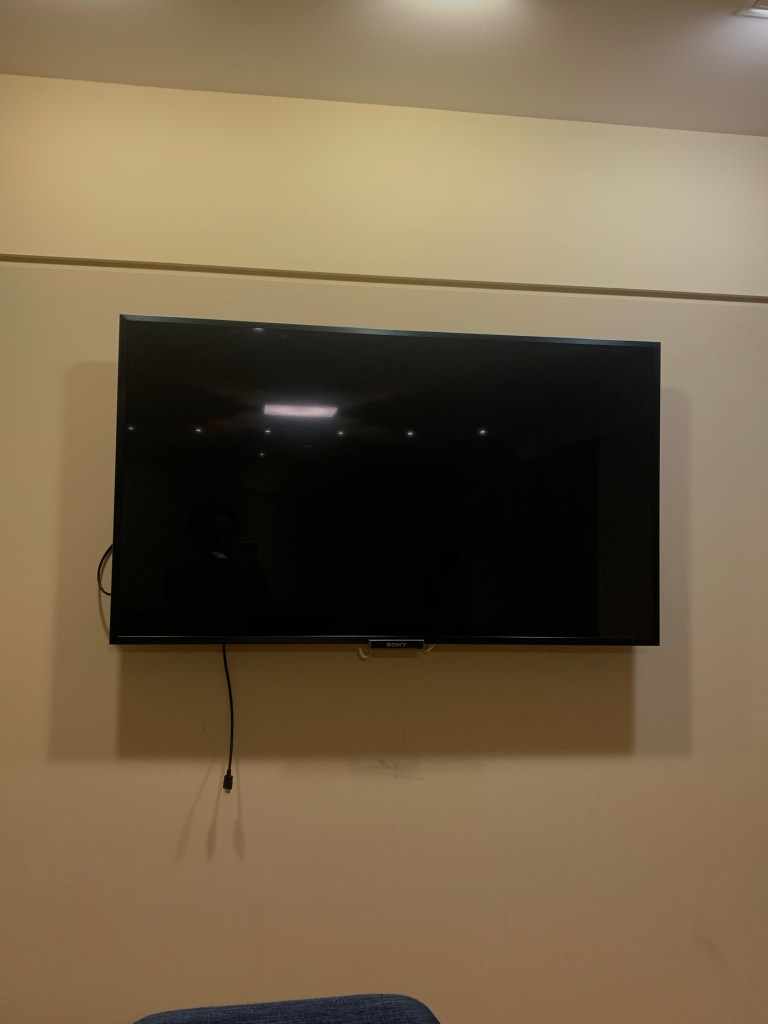
Let me give you a quick overview of how lavish residential students have it at the dorms. Picture 32-inch television screens scattered across each hallway as if they were stickers and there are a lot of halls, like a lot. Then picture, that after walking through the halls you get to your room which has it’s very own touch screen tablet, and yes, every room has a tablet attached to it. But the fun doesn’t stop there; inside each room is set with another sleek 32-inch television screen and surrounded by accessories to help better your stay.
TV’s like this are everywhere on each floor in all buildings
This TV isn’t even connected to anything… Each room comes with a touch screen… there’s a lot of rooms by the way so thats expensive
After the honeymoon phases passed, I was intrigued as a student on why is there so much high tech utilities, is it actually needed? Now don’t get me wrong, I love having the cool gadgets as much as the next guy, but I was never using it. Actually, nobody was using it at ALL. That’s what I found insane. Students at EC are immersed by the most desirable devices but are they being utilized or are they sitting down collecting dust because nobody needs them. The bigger question was, does Education City have a problem with having too much material and not enough desire to make use of it? The short question was, is there a practice in today’s digital era to discarded unwanted electronic devices and reuse, resale, recycle what goes disregarded or is money being thrown at something that no one seems to care for? You may ask, why do I care? We can skip over the moral obligation conversation for now and the ethical reasons on why in the current world today; we need to conserve the devices we used and how the world is literally dying in front of our eyes because we have an abundance of electronics that harm the environment. But I also cared because I’m paying for it. My high rise tuition that seems never to stop growing is going toward budgets like this, and we should be concerned as community members.
So as a noble concerned student, I went to complain. And see if there is a process of being efficient and “green” with this unneeded materialistic technology. And I got all the answers I needed, and everyone was so helpful and supportive. Education City is going green with everything, everything is perfect, and there is no suspicious activity going on at all 🙂
Unfourtnely, if that were true, I wouldn’t be here right now writing this piece. It turned out it was the complete opposite. No one wants to talk, like indeed no one. I thought it would be simple, ask a few questions to the IT department. Ask some questions to the housing department. I also had some connections in some of these places, so it came to my surprise when i received comments saying that this is a sensitive topic and there is a process on having this information out.
Bro what?
It didn’t make sense; what information about this topic is so secret that permission has to be granted from the higher-ups. Not only am I a student and I should not have to ask to be given this information from my very own university and the place I live and sleep in, but there’s a suppression of information going on, and it’s not right. If you think I’m exaggerating, these were the questions I tried to ask and ask yourself, is there anything sensitive about what I’m asking.
Question 1) There is an abundance of high tech at NU-Q, what are some of the pro’s and cons of the resources?
Question 2) How does facilities ensure that all utilities are being used here efficiently and effectively?
Question 3) How does NU-Q limit itself from having too much materials to having only the right amount for its students and staff?
Question 4) Laptops, tablets, when they are broken, does NU-Q attempt to fix and put it back to service? Or does it become recycled?
Question 5) Since the beginning has NU-Q, what has NU-Q’s motto been to technology? Is it having the best and most efficient products or is it something else?
These are the answers I got back from one of the sources after a couple of negotiations and a reminder that I am just a student, the rest haven’t replied and probably won’t 😦
Answer to question 1) “When at its best, NU-Q technology enhances the learning experience for students and leads to more efficient business processes for employees”
Answer to question 2) “This may be a better question for our Facilities department, but I can speak to a few details under IT’s purview. Classroom and digital signage systems operate with automated timers to conserve energy outside fo business hours. From a Facilities perspective many of the buildings lighting systems detect heat and movement to determine whether lights should be turned off in a given room.”
Answer to question 3) “Institutional technology equipment policy and budget constraints govern our acquisition of assets.”
Answer to question 4) “In general, if a repair is economical, we repair. A repair is economical if it costs less to repair than to replace with a new asset”
Answer to question 5) “When you say motto, I interpret that as what are the guiding principles that influence our technology decisions. One such principle is that when NU-Q identifies a need for a new service, we explore whether we can meet that need by leveraging an existing service offered from Evanston first, the cloud marketplace second, and only if we cannot fill a need from Evanston or the cloud do we acquire and deploy a new service locally. We follow this model to promote alignment with Evanston where possible and to reduce our ongoing support and operating expenses”
Now I could have probably asked better questions, but I was hoping these questions would be an introduction to the answers I would get. But what I really found out was there is a common code of conduct when you go asking about something that nobody seems to want to admit it. There could be nothing suspicious going on at all, but I wouldn’t know because of the limit of access to information I have as not only a student, but a concerned member of the community. Who knows, maybe I asked on a bad week. What’s important is that information regarding a common understanding should be public and not hidden especially at education institutions that believe students should have equal opportunity to access of information to anything they desire especially when that information concerns them.
Fear of missing out is one main reason why young technology users stay online longer than they need to, which puts them at risk of getting cyberbullied. Students in Education City are not an exception.
When naming the dangers of technology for kids and teenagers, cyberbullying is high on the list. However, young adults are just at risk of encountering cyber bullies and may even struggle to deal with it appropriately.
Students’ experiences
One such person is Hadeel Al-Kohaji. A 20-year-old student at Virginia Commonwealth University. Cyberbullying is something that Al-Kohaji encounters quite frequently on social media.
According to Al-Kohaji, it tends to be anonymous and mostly via comments from complete strangers on social media. She would comment on posts “like any person would” and sometimes someone would not approve of her opinion and therefore would attack her with hurtful comments rather than offer constructive criticism or just let her express her own opinion.
“There was actually a time where I ended up arguing with an atheist who’s advocating for the abolition of all religions and refused to listen to perspectives of practicing people,” she said. “That person has since ended up blocking me and several others but that’s mainly out of her own ignorance and refusal to understand different perspectives.”
On some days it is pretty draining for Al-Kohaji. “More than anyone would think,” she said. Especially since it is the only impression of her that they got. “I end up overthinking about it for ages until I faze it out with coping mechanisms.”
While she does do her best to ignore cyber bullies, she lets it slip on certain days, well aware that she would be taking the bully’s bait. “On those days I tend to feel more drained than I usually do so I end up withdrawing and taking a day to myself,” she admitted.
A few years ago, a female student* from Education City learned a valuable lesson from a painful cyberbullying experience. This student walked in on her friend when she was video messaging a strange girl from the U.K. and decided to join her. “You can tell that this girl is the type of person who stays on the computer all day,” she said.
According to the student, her friend casually chatted to the stranger, but what came next shocked her.
“She is ugly with a capital U,” the stranger said, referring to the student.
“It was the first time anyone had ever called me that. I was so shocked and it genuinely hurt me,” she said. This made the student question whether it was actually true.
How they deal with it
Al-Kohaji typically tries not to engage and directly blocks any cyber bullies, especially when the response aggravates her. Still, there are times when Al-Kohaji would cave and try to defend herself from them. “It happens in spurs though so it can go from zero to 100 real quick,” she remarked.
Al-Kohaji mostly deals with her cyberbullying experiences alone. However, there have been times where she sought help from friends when it felt too much to bear alone. “I think it’s vital to reach out to friends about something like this, especially if it happens to someone on a daily basis,” she said.
The female student has since then realized that bullies exist everywhere. “Bullying comes in many forms,” she said. “It doesn’t just come on the internet. It doesn’t just come on the playground. It can come from your friends. It can come from your family. It can come from anywhere and you don’t even realize it.”
Advice from a life coach
Being a constant technology user distracts students from the real world says life coach Shaikha Fahad Mohammed. It may potentially cause psychological trauma, she said. However, there are ways to reduce such risks. According to Shaikha, a student must be willing to limit their screen time and use only one way to communicate online. “Most of the time, people online interact without a purpose and that is a problem,” she remarked.
Cyberbullying is ultimately the result of too much screen time, which has become the primary reason why students procrastinate important tasks, Shaikha said.














 talkk.tech.blog